A quick update on drilling and logging progress: Today we boxed rock core to a depth of 5526 ft, 70 ft deeper than yesterday. We saw more ʻaʻa today than usual, in fact it was the first time in a few days that we've seen ʻaʻa at all.
Each day when we finish boxing up the newly drilled core, we head over to the rock lab and log the core's features into the database. As of the time of this blog post, we've logged to a depth of 2586 ft; 86 ft deeper than a few days ago. Soon the first hole of the project will be finished and we'll devote all of our workdays to completing the logging of all the rock recovered from that hole.
Tuesday, June 18, 2013

Monday, June 17, 2013
Processed to 5456 feet, more sediment
Today we boxed rock core to 5456 ft, 80 ft deeper than yesterday. One of the really interesting sections of rock that we saw is the sediment shown in the photos below:

 The photo on the left shows the entire interval of sediment (1.4 ft thick), while the photo on the right is a close-up view of the upper portion of this interval. Note the bedding of the sediment, and the abundance of green (altered) material that is helping cement the sediment together. The grain sizes of the sediments range from gravel to silt, but there is no particular gradation in sediment size with depth. Also note that in the upper portion of this sediment interval there are pahoehoe flow fragments (center of right photo), which presumably were eroded from their original location and ended up in the body of water where the sediments were deposited.

 The photo on the left shows the entire interval of sediment (1.4 ft thick), while the photo on the right is a close-up view of the upper portion of this interval. Note the bedding of the sediment, and the abundance of green (altered) material that is helping cement the sediment together. The grain sizes of the sediments range from gravel to silt, but there is no particular gradation in sediment size with depth. Also note that in the upper portion of this sediment interval there are pahoehoe flow fragments (center of right photo), which presumably were eroded from their original location and ended up in the body of water where the sediments were deposited.
Sunday, June 16, 2013
Processed to 5376 feet, extremely coherent rock
Today we boxed up another 100 ft of rock core, to a depth of 5376 ft. Below is a picture of the rock that was drilled last night, which we processed this morning. When fractures are this rare, the rock generally can be drilled more easily to produce full runs and it is also easier to process and interpret.
 Note: Each tray is 6 ft in length, with the top ends painted. There are pieces of circular foam at each end and a cover on each tray during transport. Wooden blocks with the bottom depth of each run written on them are placed at the end of each run. A full run is 10 feet in length. With the foam and wood blocks and fractured rock, one run nearly or completely fills two trays.

Saturday, June 15, 2013
Processed to 5276 feet, logged to 2500 feet
Today we boxed rock core to a depth of 5276 ft, 70 ft deeper than yesterday. The slightly lower amount of rock drilled was due to an upgrade of a few parts on the drill rig, which will help the crew save time in the long run.
Down here at UH Hilo, less core means more time we spend logging. We've now logged just past 2500 ft. Sorry today is just another text update, I promise a picture tomorrow.
Down here at UH Hilo, less core means more time we spend logging. We've now logged just past 2500 ft. Sorry today is just another text update, I promise a picture tomorrow.
Friday, June 14, 2013
Processed to 5206 feet
Just a quick text update on the drilling progress: Today we processed another 80 ft to a depth of 5206 ft. The drillers seem to have this recovery rate dialed in, hitting it on the dot nearly every day. The bit they're using has lasted over 1000 ft so far, and could finish this hole. Today was rainy and not great for pictures, tomorrow I'll try and post a photo of some of the interesting rock we've been seeing.
Thursday, June 13, 2013
Processed to 5126 feet, moved more boxes of rocks around
Just a quick update today on our progress. This morning we boxed rock core to a depth of 5126 ft, 80 ft deeper than yesterday. After that, it was time to move all the boxes we've logged out of the rock lab, onto a pallet, and into storage. Finally, we filled the lab with new boxes to log and shifted other boxes into the drying area.
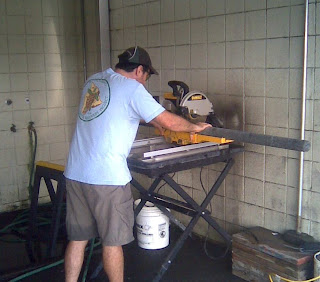 Above, Mike uses the rock saw to cut a particularly long, unbroken piece of rock core into two-foot sections that will fit in the core box.

Wednesday, June 12, 2013
Processed to 5046 feet, logged to 2444.3 feet, sandstone unit
Today we processed rock core to a depth of 5046 ft, 160 ft deeper than two days ago. The drilling is in the home stretch of this first hole now, as we're fast approaching the 6000-6500 ft target depth. At this rate, we could complete the first hole in 2-3 more weeks. Each afternoon we continue to log the rocks, and by the end of today we've logged some interesting units to a depth of 2444.3 ft. Below is a picture of the first sandstone unit we just recently logged (field of view is ~3 cm across)
 This sandstone is made up of olivine grains (green), lithic fragments of basalt (black or gray), hematite (rusty orange), and a variety of other white to clear secondary minerals like calcite and zeolites produced by physical and chemical weathering of the original rock. The sand has been compacted by the weight of over 2000 ft of rock resting on top of it, and weakly cemented together by secondary mineral growth. The average grain size and degree of sorting indicate that this sand is fluvial in origin (deposited by a stream). However, the angularity of the grains and lack of bedding indicate such a stream was probably ephemeral and may have washed the sand downslope to its final resting point in as little as one heavy rain event.

Subscribe to:
Posts (Atom)