
Tuesday, April 30, 2013
Logged to 1398.5 feet, learning more about fracture fill
We logged 95.1 ft of boxed rock core today, ending the day at a depth of 1398.5 ft. Most of the day was spent logging, with a brief break to move boxes between the different buildings and areas we use. We're starting to get to depths with a lot of "fracture fill," which interestingly remains a bit wet even after days in the drying area. My current theory about this material is that it is water-absorbing clay produced by chemical interaction of the rock and volcanic glass with groundwater. We hope to study this fracture fill material over the summer and figure out the details of its composition. Here is a picture of what it looks like in a pahoehoe flow, filling multiple fractures in and around the vesicular lava:


Monday, April 29, 2013
Logged to 1303.4 feet
Today we had all three core loggers hard at work with no distractions, and we were able to log 129.8 ft of rock down to 1303.4 ft. Most of the rock was pahoehoe, we only logged one ʻaʻa flow. We hope to get a lot of logging done this week, all three core loggers will be working most days. The only thing that will slow us down a bit is moving core boxes into and out of the drying area, the logging area, and the storage area.
Sunday, April 28, 2013
Logged to 1173.6 feet, moving boxes around, drilled through the flank of a cinder cone!
Yesterday much of our day was spent moving core boxes from the rock lab to the armory, bringing new boxes to the lab to be logged, and bringing deeper boxes into the drying area. As a result, we didn't get that much logging done until today. We have now logged another 111.5 ft to a depth of 1173.6 ft, and we still haven't quite reached the base of that alternating pahoehoe/cinder sequence I mentioned in the last post. Here's a representative image from our log reports of one of the box units within the sequence:
 As you can see, this box unit contains the 31st and 32nd cinder fall deposits of the sequence. At the depth shown in the photo, there are 32 mineralogically similar pahoehoe flows in the sequence as well. I suspect we've drilled through the flank of a stratified cinder cone that may have almost constantly produced both lava flows and cinder fall deposits as it grew. Thin, hot pahoehoe flows like the ones we've been logging are known to dominate the near-vent flanks of such cones. From top to bottom, this sequence is ~190 ft thick and contains 40 cinder/pahoehoe intervals. For comparison, the currently active Puʻu Oʻo cone on Kilauea's east rift zone had 44 eruptive episodes in only three years while building to its maximum summit height of 837 ft, and produced both lava flows and cinder fall deposits during this time.

Friday, April 26, 2013
Logged to 1062.1 feet, an olivine cumulate xenolith
Today we logged rock core boxes to a depth of 1062.1 ft, 73.5 ft deeper than yesterday. Interestingly, almost all of our logging was dedicated to a single unit that we still haven't found the base of yet. This unit is a series of alternating cinder fall units and pahoehoe lava flows that all exhibit the same distinct mineralogy: moderately olivine plagioclase-phyric basalt (the mineral plagioclase is present as phenocrysts composing 3-10% of the rock, and plagioclase is always more abundant than olivine the olivine phenocrysts). Hopefully tomorrow we'll finish logging this unit and by then we'll understand it better.
 The photo above is a close-up shot of one of the pahoehoe flows from the unit we spent most of the day logging. I think the photo shows a xenolith or grouping of olivine crystals that accumulated in the magma chamber just before eruption. Olivine is a dense mineral that often accumulates along the bottom or sides of magma chambers, but we haven't seen a grouping like this but once before in the core.

Thursday, April 25, 2013
Logged to 988.6 feet, a piece of transitional core
Today we were able to log core boxes to a depth of 988.6 ft, 57.1 deeper than yesterday. We encountered another transitional flow, and here is an illustrative example of how sudden the transition between pahoehoe and ʻaʻa can be in these types of flows:
 The piece of core I'm holding in my hand shows a sharp transition from spongy pahoehoe to typical ʻaʻa with no associated process at all. The transitional flow we logged today routinely switched back and forth between flow types without producing any contacts, while of course maintaining the same mineralogy throughout.
Once we finish logging this unit, the rocks only get trickier just below. Stay tuned to see what we decipher tomorrow.

Once we finish logging this unit, the rocks only get trickier just below. Stay tuned to see what we decipher tomorrow.
Wednesday, April 24, 2013
Logged to 931.5 feet, another tricky transitional unit
We were able to log core boxes to 931.5 ft today, 62.9 ft of material that was difficult to interpret. After finishing logging an intrusion and sampling some glassy scoria, we ran into another unit that showed both characteristics of pahoehoe and ʻaʻa. On top of that there was a lot of extra "cave-in" material due to rock falling in around the drill string at the time this core was recovered, so we had to proceed slowly and carefully while logging today. Eventually we were able to determine the top, bottom, and internal boundaries of this transitional unit and get it logged. Tomorrow's boxes contain rock that is quite different but also challenging to interpret for different reasons, stay tuned to hear what we manage to figure out about these rocks.
Tuesday, April 23, 2013
Logged to 868.6 feet, first transitional unit
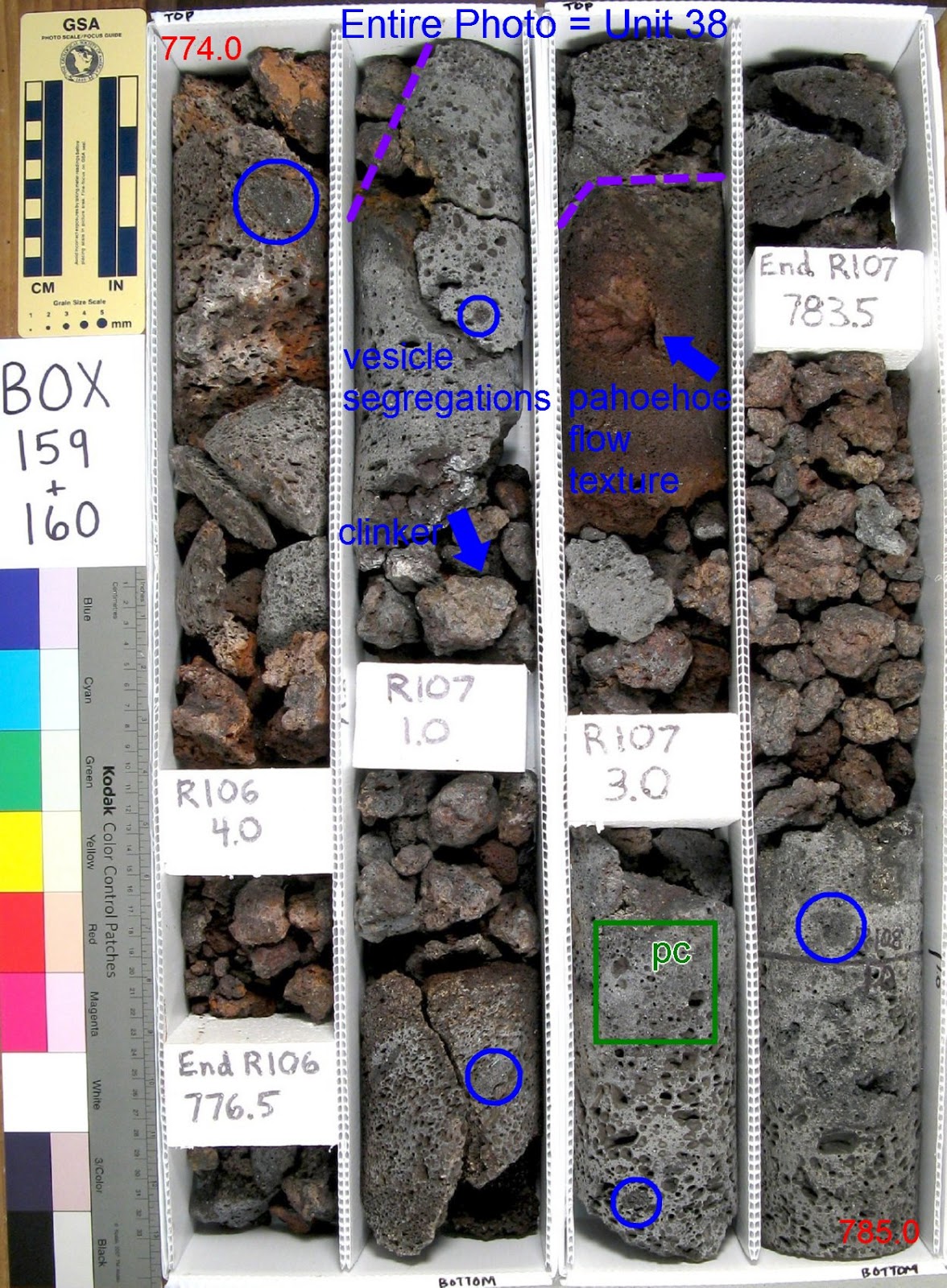
Today we were able to log core boxes to a depth of 868.6 ft, that's 125.6 ft logged in a single day. Not bad since I was called away multiple times to help out with other duties. Since we're doing so much logging, I thought I'd show you an example of the annotated photos that we're including in our log reports:
 As you can see, there are two core boxes in each logging photo. We add a distance and color scale on the left side of the photo, and label the top and bottom depths of rock shown in the photo in red. Features are usually circled or pointed to and labeled in blue, and any contacts (none in this photo) are drawn with a thick blue line. The purple dashed lines refer to internal boundaries within a unit (e.g. pahoehoe flow lobe boundaries that are formed when lobes with the same lithology are emplaced on top of each other during the same eruptive event). The green box and "pc" inside show the location where a point count was taken to quantify the mineralogy and vesicularity of the rock unit. The rock in the photo above is interesting because it has characteristics of both an ʻaʻa and a pahoehoe flow, this was the first unit we've logged where we had to call the flow type "transitional." There is additional information about the rock in each photo in text form on the facing page of the photo in our final log reports.
Subscribe to:
Posts (Atom)