
Tuesday, June 3, 2014
Scanning secondary minerals deep in the borehole
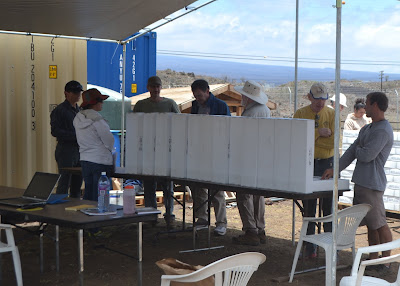
Last week we spent three days up at the PTA borehole site with distinguished guest Dr. Wendy M. Calvin from the University of Nevada at Reno. She showed us how to use a field spectrometer to take spot spectral scans of secondary minerals that formed in the lower half of the borehole (~3,000-6,000 ft below the surface). These minerals grew due to chemical weathering interaction between groundwater and the rock. Now that the data has been collected, we'll be working and corresponding with Dr. Calvin to more accurately identify the main set of secondary minerals that are present in the hole. These minerals will provide more information about the water and other resources deep in the borehole. In the photo below, Dr. Calvin performs a spot scan while technician David Dow prepares the next box for scanning and Dr. Nicole Lautze takes notes on each scan location. Drilling hand Donnie Mulliken also assists in the background with unstacking and re-stacking pallets of core boxes.
Although there hasn't been a blog post on this site in a while, we have been busy planning for the second borehole and a water pump test of the first hole. The pump test will happen first, stay tuned for pictures of that activity when it happens this summer!

Thursday, February 20, 2014
Our project makes the local news
Aloha blog followers, our project was recently covered in the local Hawaii Tribune-Herald newspaper here. Since the last blog post, we have presented preliminary results at the American Geophysical Union fall conference and arranged additional collaboration with scientists eager to study different aspects of the rocks and borehole. We are currently involved in a number of behind-the-scenes activities in preparation for drilling the second hole, and the news article coincides with the permitting process for the second hole being under way. Stay tuned for a post showing startup activities, hopefully within the next few months.
Friday, September 13, 2013
Finished logging, editing logs, preliminary sampling
Over the past few weeks we have continued to stay busy working on the rock core. We finished logging at the end of August, and started right up on editing the logs for consistency and clarity. So far, we have edited up to about Box 400 (~1670 feet).
 In addition to these activities, we also spent a couple days earlier this week taking preliminary samples from throughout much of the hole. In the photo above there are 32 whole-rock samples made up of twenty aphyric rocks, seven intrusive units, and five picrites (>12% olivine). The chemistry of these samples will be analyzed over the next couple months, and hopefully at least a few of them will be suitable for Ar-Ar dating as well. The results of this preliminary work will then form the basis of further proposals to study the rocks in greater detail.

Thursday, August 22, 2013
Logged to 5484 feet, microscopic views of secondary minerals
Despite the lack of regular blog updates, we have been steadily logging the deepest core of the project over the last couple weeks. At the end of today, we have logged to a depth of 5484 ft - only 302 ft to go! The highly altered rocks contain a host of exotic zeolite minerals, see below for a couple pictures taken with our new microscope camera:


Both photos were taken at 40X magnification, and are probably different minerals of the zeolite family commonly formed by weathering of Hawaii basalts. The upper photo shows a worm-shaped pattern of crystal growth that is unlike anything we've seen before, but there is very little of that material that is easy to extract. We have gathered enough of the fibrous material in the lower photo that we can analyze in the near future via X-Ray Diffraction (XRD).
Upcoming work to be done soon: Finishing the logging and editing all the logs for consistency, compiling a graphical log showing the stratigraphy of the hole, and sampling throughout the hole for preliminary analyses that will spur research proposal efforts.
Tuesday, August 6, 2013
An important science visit
This past weekend was an eventful one for our project, we hosted a visit from a number of prestigious geologists who would like to study the recovered rocks. Over the course of the weekend, our visitors reviewed many notable rock depth intervals from the drill hole. They also discussed what the most urgent scientific questions might be that study of these rocks could answer. I would like to thank these visitors again for making the trip and braving the dust, wind, and heavy lifting required to get a firsthand look at the rock samples. Mahalo!
 Above is a photo of our visitors and some of our crew posing with the drill rig. From bottom left to right: Dr. Michael Garcia (UH Manoa), Rock & Data Manager Eric Haskins (UH Manoa), Dr. Nicole Lautze (UH Manoa), Dr. J. Michael Rhodes (UMass), and Principal Investigator Donald Thomas (UH Manoa). Dr. Donald DePaolo (UC Berkeley) stands halfway up the stairs. Top row from left to right: Core Processing Technician Brandon Jasper (UH Hilo), Core Processing Technician Meghann Decker (UH Hilo), Dr. Edward Stolper (CalTech), and Core Processing Technician Bryan Patterson (UH Hilo). Photo courtesy of undergraduate Kaʻo Sutton (Carleton College). PhDs are listed with their employing institution, graduates with their degree-granting institution. Below is an image of most of these people reviewing and discussing some of the rock core boxes (Kaʻo Sutton second from right).


Tuesday, July 30, 2013
Logged to 4900 feet, a full team of loggers today
Apologies for the long interval with no blog updates, we have continued to log core nearly every day since the last post. The logging has been progressing a bit more slowly though, as alteration of the rock has made it more difficult to interpret. We have currently logged to ~4900 ft, and are slowly but surely closing in on the final depth of 5786 ft.
 When we have a full team of four core loggers all working on the same day, we're able to get a lot of logging done. Here from left to right - Bryan, Katie, Eric, and David are each logging consecutive boxes and generating a logging report or reports for the unit or units contained in their box. The four loggers also discuss relationships among units that begin in one box and end in another, and help each other with interpreting the rock features.

Wednesday, July 10, 2013
Logged to 3901.6 feet, interpreting through a haze of alteration, complex flow/intrusion interaction
Despite the lack of blog updates lately, we have been busy logging box after box of core. At ~3775 ft or so, the rock starts showing more alteration than above. Some of the rock is so altered that little to no primary minerals are visible. Vesicles are often partially or completely filled by clays and/or zeolites, and even the groundmass of the rock can be obscured by weathering products. So far every unit contains enough decent rock for us to determine its basic features, though some of them are made more subtle by the overprint of alteration on the rock. From boxing all this rock earlier, we know that the alteration will only increase with depth so we'll have to do the best we can to understand the rocks and how alteration has changed them.
 On a different note, the photo above is taken from one of our annotated core box logs. Note the nearly vertical, complex interaction between units 216 & 217a (an aa flow and the dike that intrudes it, respectively) that persists for over five feet and extends into the next box where the interaction becomes too complex to trace! The highly fractured fourth column of the box contains a mixture of aa and dike fragments that could not be pieced back together into their original orientation, thus the vertical contact line indicating the two units share this column. There were a number of dikes near this depth interval in the core, but now that we've logged through this swarm of them there are only one or two more the rest of the way to the bottom of the hole.

Subscribe to:
Posts (Atom)